


Buying a walking cane for someone else is a different task than buying one for yourself. You can't try it out for height, you may not know their preferred grip, and if it's wrong, they're stuck with a gift that sits in a closet rather than gets used. This checklist covers the five things worth confirming before you buy — height, hand dominance, handle shape, weight capacity, and how easy it will be to fix if something's off.
Before you buy, check:
- Do you know their height, or can you measure a cane they already own?
- If you're considering a Palm Grip or anatomically molded handle, do you know which hand they'd favor? (Not needed for Derby, Fritz, Knob, Offset, or Tourist — those fit either hand.)
- Do you know if they have arthritis, wrist pain, or reduced grip strength?
- Do you know roughly how much they weigh?
- Can you return or exchange it if the size or style is wrong?
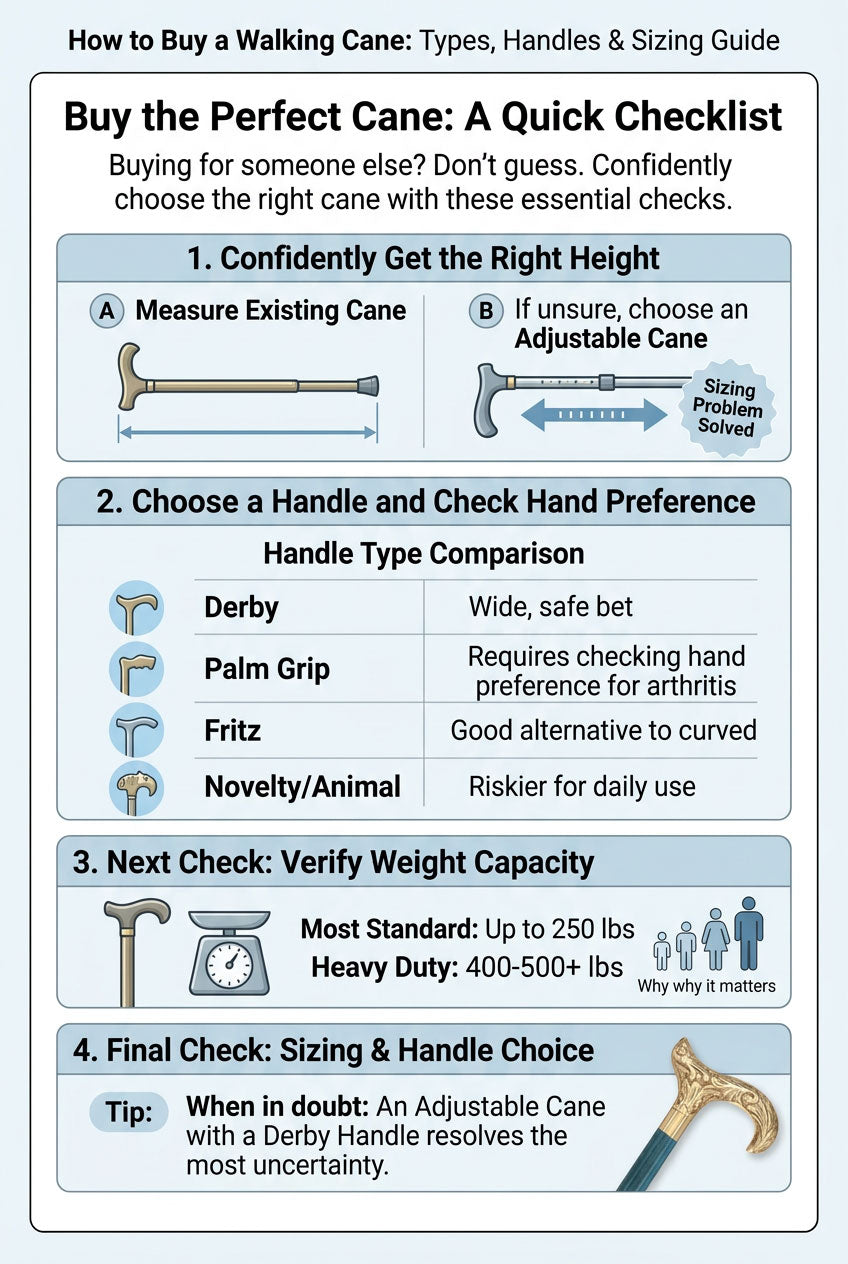
1. Get the height right
Height is the detail most likely to make or break a gift cane. The wrong height changes posture and can make the cane harder to use rather than easier, so it's worth spending the most effort here.
If the person already owns a cane, measuring it directly is the most reliable option: measure from the top of the handle down to the bottom of the rubber tip, and match that length. If you don't have access to their current cane, our guide to measuring for a cane walks through how to size one using height and arm length instead.
If neither is possible — which is common when a cane is meant to be a surprise — an adjustable cane sidesteps the problem, since it can be sized correctly after it's unwrapped.
2. Hand preference — usually optional, sometimes worth checking
For most handle shapes, which hand someone holds the cane in doesn't matter at all. Derby, Fritz, Knob, Offset, and Tourist handles are all symmetric — they're comfortable in either hand, so this isn't something you need to figure out before buying.
The exception is Palm Grip and other anatomically molded handles, which are shaped to fit one specific hand more comfortably than the other. If you're considering one of these, it's worth confirming which hand the person favors for their cane — typically the one opposite their weaker leg. But this is a comfort upgrade, not a requirement: a standard handle shape works perfectly well without knowing this, and is the simpler choice if you're not sure.
3. Choose a forgiving handle shape
If you don't know their exact handle preference, a few shapes are safer bets than others:

Derby is the most widely used shape and a reasonable default if you have no other information.

Palm Grip or Ergonomic are worth choosing instead if you know they have arthritis, carpal tunnel, or general wrist discomfort, since both spread pressure across the hand rather than concentrating it.

Fritz is a good alternative to Derby if they've mentioned finding curved handles uncomfortable.

Novelty shapes like Animal handles are fine as an accent piece, but they're a riskier choice as someone's primary, daily-use cane.
4. Check weight capacity
Every cane has a maximum weight rating, typically listed on its product page — usually around 250 pounds for a standard cane and up to 400–500 pounds for a heavy duty or extra-strong model. This is easy to overlook when buying for someone else, since it's not something most people think to ask about, but exceeding a cane's rated capacity affects both its stability and how long it lasts.
5. Reduce the risk of getting it wrong
Even with all four points above accounted for, gift sizing carries some inherent guesswork. Two things reduce that risk substantially:
Choosing from our adjustable canes removes height as a variable entirely — most models adjust across a wide enough range to fit nearly any adult, so a rough guess is enough to get started.
Confirming the return or exchange policy before you buy means a wrong handle shape or a size that's slightly off isn't the end of the story. If you're weighing cane types and handle shapes side by side before deciding, our full cane buyer's guide covers both in more detail than this checklist does.
The short version
If you only take one thing from this: when in doubt on more than one point, an adjustable cane with a Derby handle resolves most of the uncertainty in a single choice, and it's the combination most people land on when buying a cane as a gift.
Shop by handle shape
If you already know which handle shape is right for your gift, you can browse that style directly:
|
Derby handled canes |
|
Fritz handled canes |
|
Palm Grip handled canes |
 |
Ergonomic handled canes |
 |
Knob handled canes |
|
Animal handled canes |
 |
Offset handled canes |
 |
Tourist handled canes |

About the Author: Stephen W Carroll III
Stephen is the founder and CEO of Fashionable Canes. He started the company in 1999 out of a personal frustration when he couldn't find a stylish, high-quality walking option for his father. Since then, Stephen has traveled the world to source and design hundreds of unique cane designs—pioneering innovations like clear acrylic StyleStix™, FashionStix™, and Royal Canes™ Brands. You can connect with Stephen on LinkedIn or learn more on his official bio page.


